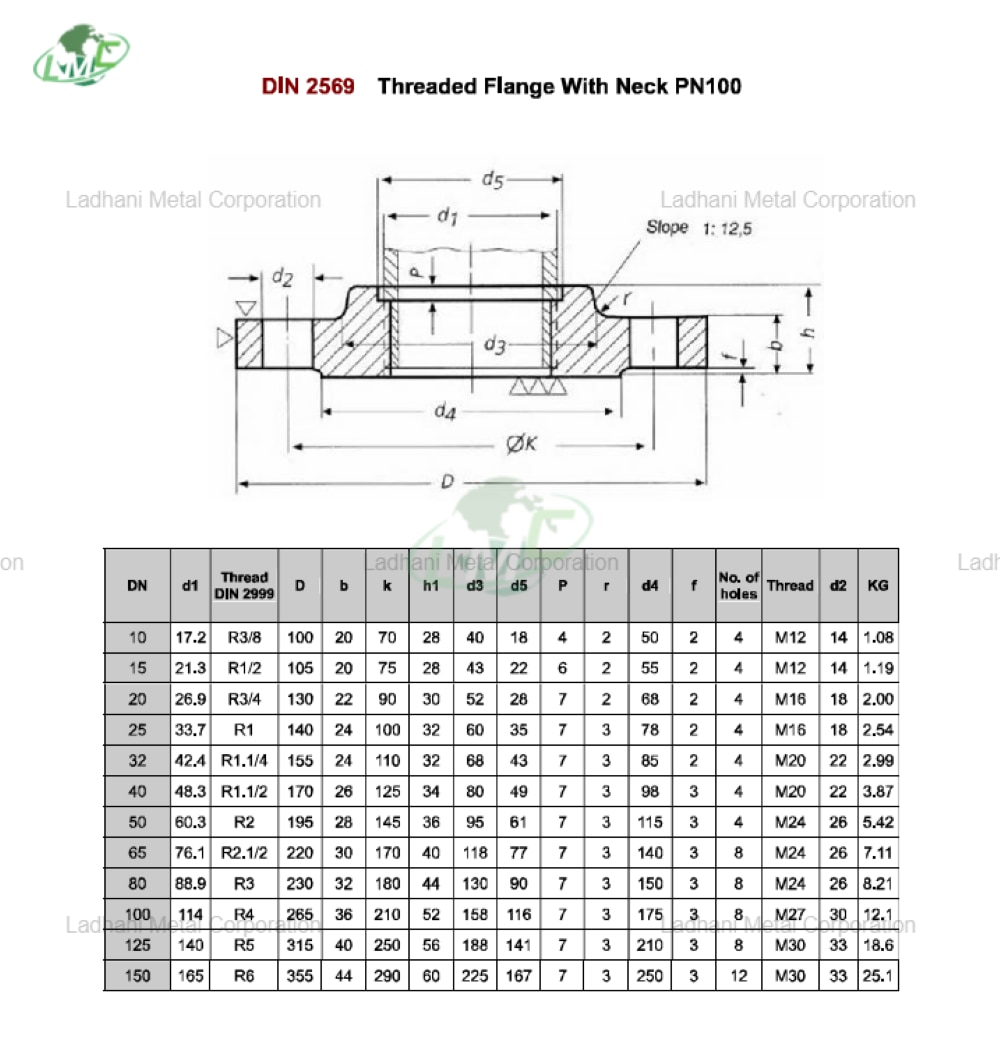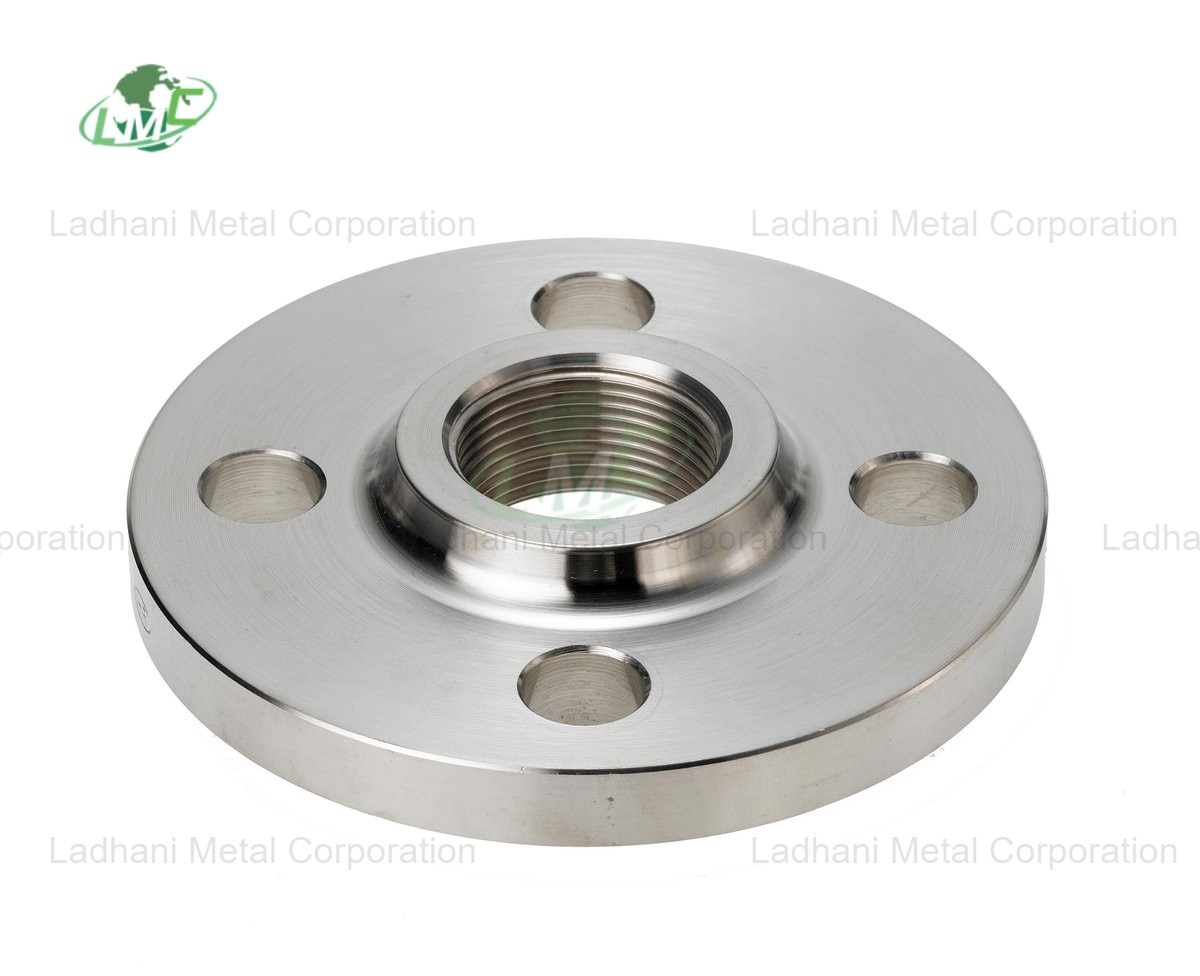

Introduction
to Flanges
A flange is a mechanical component used
to connect pipes, valves, pumps, and other equipment to form a piping system.
It provides a secure, leak-proof connection that allows for easy assembly,
disassembly, and maintenance. Flanges are typically joined by bolting and are
sealed using gaskets to ensure a tight seal under pressure.
Flanges are
essential in industries such as oil and
gas, petrochemical, water treatment, power generation, and manufacturing,
where they facilitate the safe transport of fluids and gases. They are
manufactured in various types and pressure ratings to suit different operating
conditions, such as temperature, pressure, and fluid characteristics.
What is a Threaded
Flange?
A
threaded
flange (also known as a "screwed flange ") is a
circular flange that includes a tapered hub (neck) for additional strength and
a central threaded bore that allows for easy, welding-free connection to a
male-threaded pipe.
This
design combines the convenience of a threaded connection with the
strength-enhancing benefits of a neck or hub. The neck allows for better stress
distribution, particularly in high-load or vibration-prone systems.
Threaded
flanges with neck are specialized mechanical connectors used in piping systems
where welding is impractical or undesirable. These flanges are manufactured
according to strict dimensional and material standards to ensure reliable
performance in applications that range from low-pressure utility piping to
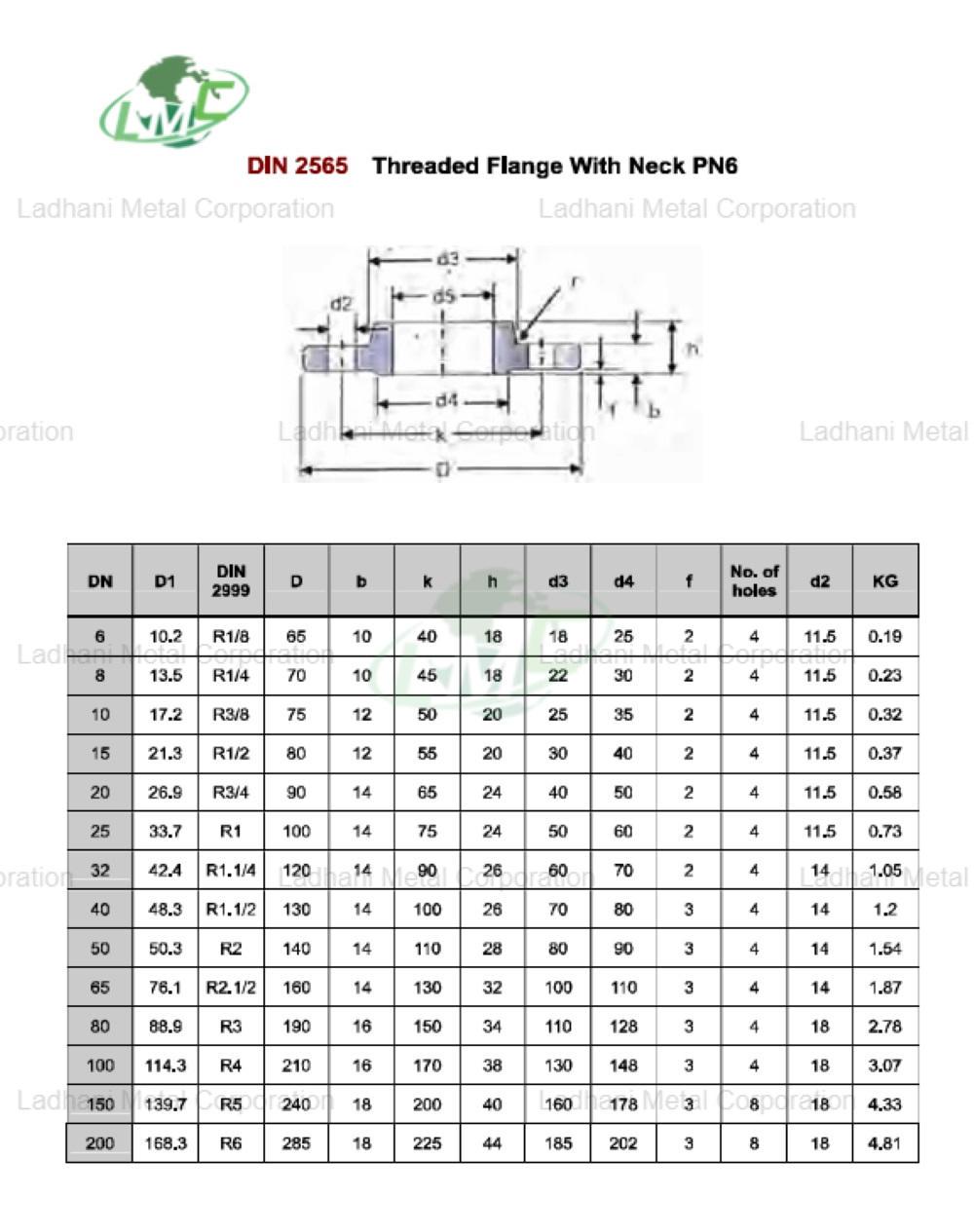
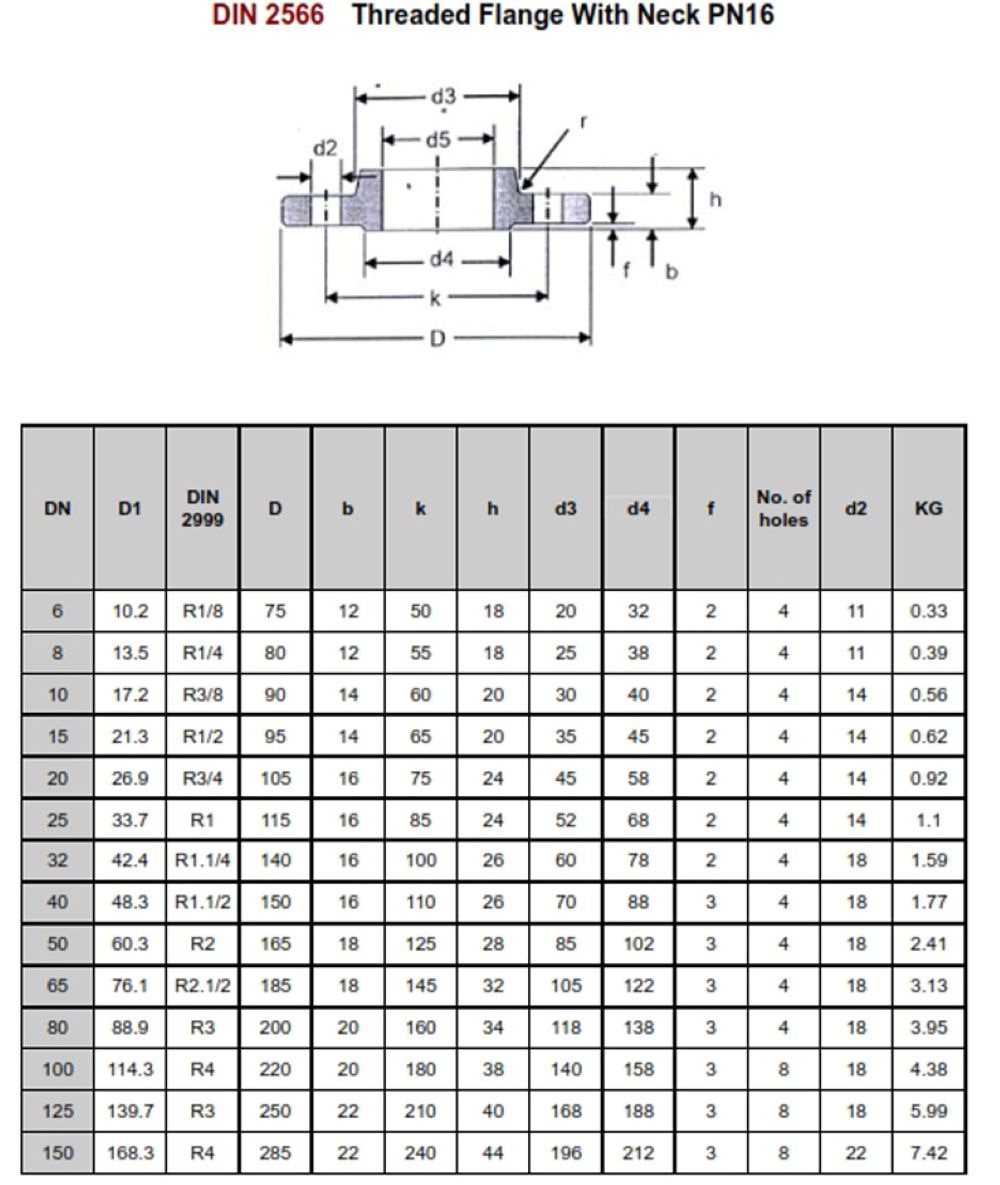
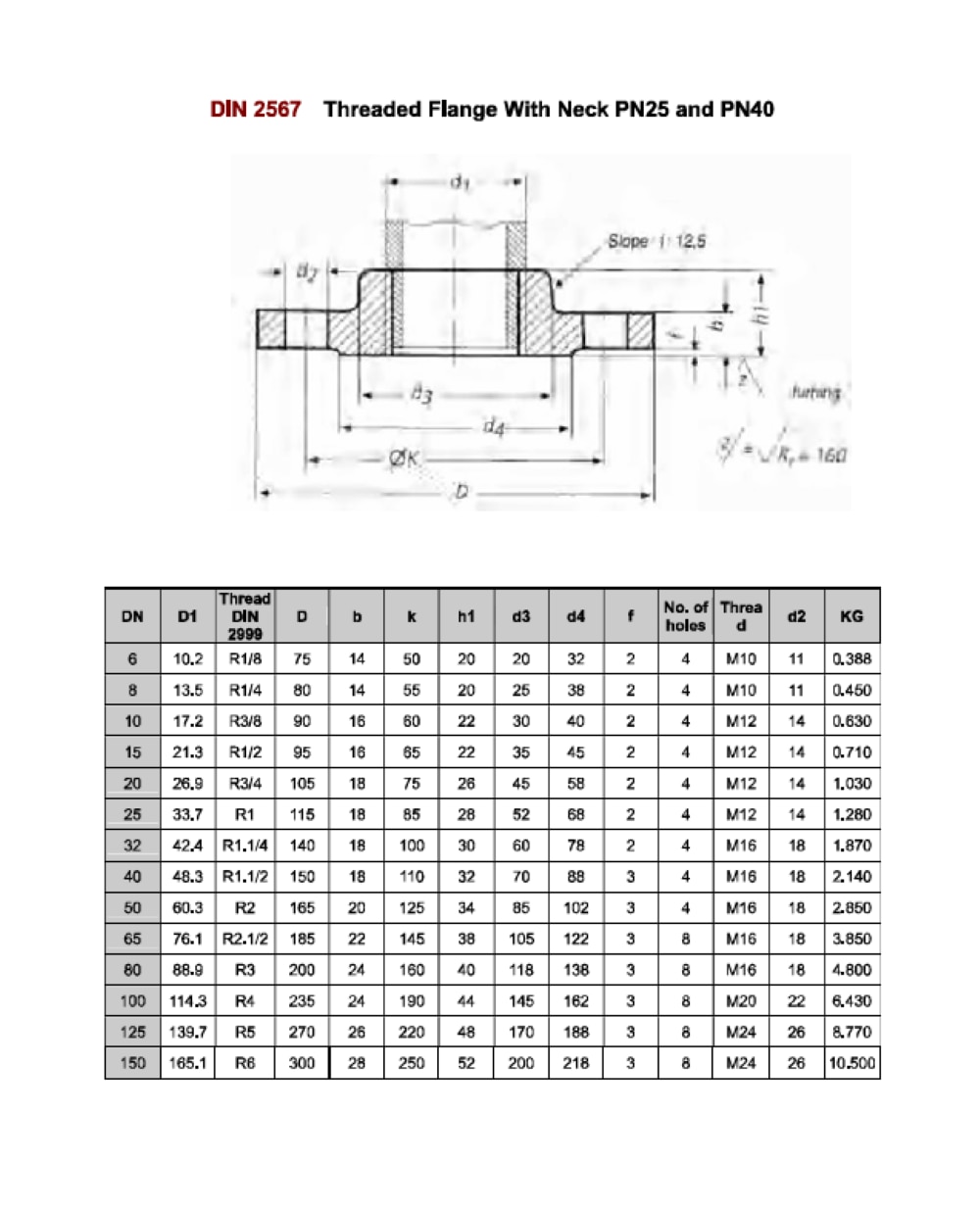
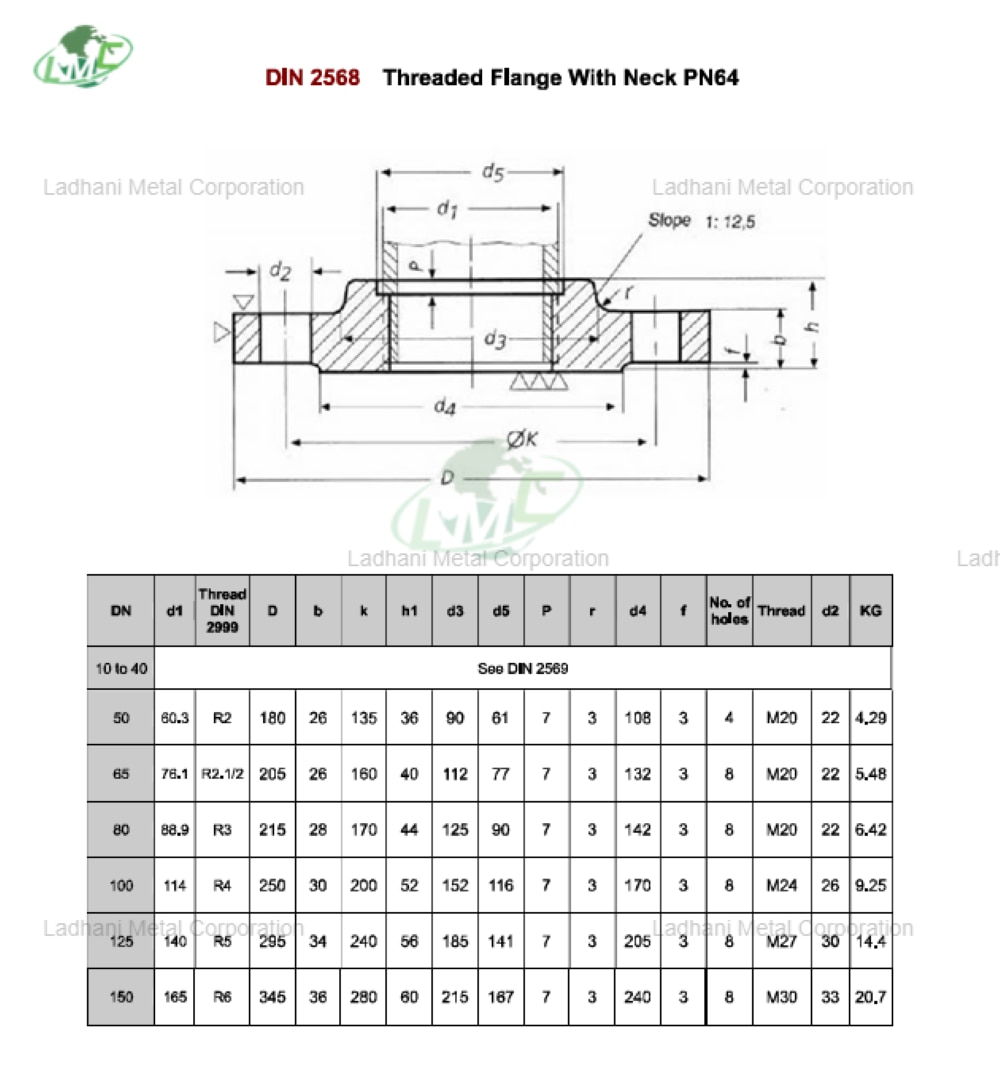
high-pressure industrial systems. In particular, the DIN 2565 to DIN 2569
series defines a range of threaded neck flanges designed to handle different
pressure ratings, materials, and industrial use cases.
PN
Rating
The PN rating (short for Pressure
Nominal or Pressure Number) is a designation used to indicate the pressure capacity of a flange in bar (metric unit of pressure). It’s
part of a standard system mainly used in Europe and countries that follow EN or ISO standards.
What PN Rating Means:
- PN
10, PN 16, PN 25, PN 40, etc. are common PN ratings.
- The number refers to the maximum pressure (in bar) the flange can
handle at a reference temperature, usually 20°C (68°F).
- 1 bar
≈ 14.5 psi, so
for example:
- PN
10 = 10
bar ≈ 145 psi
- PN
16 = 16
bar ≈ 232 psi
- PN
40 = 40
bar ≈ 580 psi
- PN
64 = 64
bar ≈ 928 psi
- PN
100 = 100
bar ≈ 1450 psi
Why PN Rating Matters:
- Determines the wall thickness, bolt size, and flange
dimensions.
- Helps ensure compatibility between different
components in a pipeline (e.g., pipe, flange, valve).
- Affects material choice—higher PN means stronger (and usually more
expensive) materials.
DIN Standards for Threaded Flanges with Neck
The
DIN 2565–2569 standards provide specifications for threaded flanges with neck
across various pressure ratings. Each standard number corresponds to particular
pressure class and flange geometry.
|
DIN Standard |
Pressure Rating |
Typical Use |
|
|
DIN
2565 |
PN
6 |
Low-pressure systems |
|
|
DIN
2566 |
PN
16 |
Water pipelines, light-duty industrial |
|
|
DIN
2567 |
PN
25, PN 40 |
Steam, gas, and chemical service |
|
|
DIN
2568 |
PN
64 |
Medium-pressure process lines |
|
|
DIN
2569 |
PN
100 |
High-pressure steam, oil, and chemical
systems |
Design Features
- Threaded Bore:
Internal threading allows connection without welding, making installation and removal fast and easy. - Reinforced Neck (Hub):
The neck transitions smoothly from the pipe to the flange, reducing stress concentrations and improving mechanical performance. - Sealing Faces:
Available with raised face (RF), flat face (FF), or custom sealing surfaces. The RF type is standard for higher pressure flanges (DIN 2568/2569). - Bolt Holes:
Drilled according to DIN bolt circle dimensions to ensure compatibility with mating flanges and piping components.
Types of Flanges:
1. Weld Neck Flange
A flange with a long neck welded to the pipe for strength
and stress distribution, used in high-pressure systems.
2. Slip-On Flange
Flange that slips over the pipe and is welded inside
and outside, suitable for low-pressure applications.
3. Socket Weld Flange
Flange with a socket where the pipe fits, fillet-welded,
ideal for small high-pressure lines.
4. Threaded Flange
Screwed onto a threaded pipe, allowing easy assembly
without welding, used in low-pressure or hazardous areas.
5. Lap Joint Flange
Flange used with a stub end and not welded to the
pipe, making it ideal for systems requiring frequent disassembly.
6. Blind Flange
Solid disk used to block off a pipeline or valve,
ensuring no flow through the connection.
7. Orifice Flange
Flange designed with pressure taps to measure flow
through an orifice plate, commonly used in metering systems.
8. Spectacle Blind Flange
Flange that alternates between an open and closed
position to control flow without removing the flange.
Applications
Threaded
flanges with neck are used across numerous industries, especially where non-welded connections are
preferred for ease of maintenance, disassembly, or field
installation.
- Water Treatment & Distribution
Easy installation for pumping stations and filtration units. - Chemical and Petrochemical Plants
Suited for corrosive fluids under varying pressures. - Oil and Gas Pipelines
Used in high-pressure manifolds, pumps, and compact systems. - HVAC Systems
Employed in chilled water and condenser piping systems. - Steam and Condensate Lines
Preferred where welding is risky or impossible.
Advantages of Threaded Flanges with Neck
- No Welding Required:
Ideal for hazardous or confined locations. - Strong and Durable Design:
Neck adds strength and reduces fatigue and stress at the joint. - Reusable:
Threaded connection can be disassembled and reused without damage. - Versatile Material Options:
Can be used in highly corrosive or cryogenic environments. - Wide Range of Pressure Classes:
Covers everything from low-pressure water systems to high-pressure chemical pipelines.
Material Grades & Chemical Composition
DIN
2565–2569 threaded flanges with neck are manufactured in a variety of materials
to meet the diverse needs of pressure, temperature, and corrosion resistance
across industries. Below is a breakdown of commonly used material grades with
their typical chemical compositions:
1.
Titanium
|
Grade |
Standard |
Composition (% by weight) |
|
Grade 2 (CP-Ti) |
ASTM B381 |
Ti ≥ 98.9, Fe ≤ 0.30, O ≤ 0.25, C ≤
0.08, N ≤ 0.03, H ≤ 0.015 |
|
Grade 5 (Ti-6Al-4V) |
ASTM B381 |
Ti ~90, Al 5.5–6.75, V 3.5–4.5, Fe ≤
0.40, O ≤ 0.20 |
2. Stainless Steel
|
Grade |
Standard |
Composition (% by weight) |
|
ASTM A182 F304 |
SS 304 |
C ≤ 0.08, Cr 18.0–20.0, Ni 8.0–10.5,
Mn ≤ 2.0, Si ≤ 1.0 |
|
ASTM A182 F316 |
SS 316 |
C ≤ 0.08, Cr 16.0–18.0, Ni 10.0–14.0,
Mo 2.0–3.0, Mn ≤ 2.0, Si ≤ 1.0 |
Applications:
Excellent for corrosion resistance in water, chemicals, marine, and food-grade
systems.
3. Duplex & Super Duplex Stainless Steel
|
Grade |
Standard |
Composition (% by weight) |
|
Duplex S31803 |
ASTM A182 F51 |
Cr 21.0–23.0, Ni 4.5–6.5, Mo 2.5–3.5,
N 0.10–0.22, C ≤ 0.030 |
|
Super Duplex S32750 |
ASTM A182 F53 |
Cr 24.0–26.0, Ni 6.0–8.0, Mo 3.0–5.0,
N 0.24–0.32, C ≤ 0.030 |
|
Super Duplex S32760 |
ASTM A182 F55 |
Cr 24.0–26.0, Ni 6.0–8.0, Mo 3.0–4.0,
Cu 0.5–1.0, W 0.5–1.0 |
4. Inconel (Nickel-Based Alloys)
|
Grade |
Standard |
Composition
(% by weight) |
|
Inconel 600 |
UNS N06600 |
Ni ≥ 72, Cr 14–17, Fe 6–10, Mn ≤ 1.0,
Si ≤ 0.5, C ≤ 0.15 |
|
Inconel 625 |
UNS N06625 |
Ni ≥ 58, Cr 20–23, Mo 8–10, Nb + Ta
3.15–4.15, Fe ≤ 5.0 |
|
Inconel 718 |
UNS N07718 |
Ni 50–55, Cr 17–21, Fe bal., Nb
4.75–5.5, Mo 2.8–3.3, Ti 0.65–1.15, Al ≤ 0.8 |
Applications:
High strength at elevated temps, used in aerospace, nuclear, marine, and gas
turbines.
5. Monel
|
Grade |
Standard |
Composition (% by weight) |
|
Monel 400 |
UNS N04400 |
Ni ≥ 63, Cu 28–34, Fe ≤ 2.5, Mn ≤ 2.0,
Si ≤ 0.5, C ≤ 0.3 |
|
Monel K500 |
UNS N05500 |
Ni 63, Cu 29–33, Al 2.3–3.15, Ti
0.35–0.85, Fe ≤ 2.0 |
Applications:
Used in marine, sour gas, pump shafts, and saltwater systems due to corrosion
resistance.
6. Carbon Steel
|
Grade |
Standard |
Composition (% by weight) |
|
ASTM A105 |
Forged Carbon Steel |
C ≤ 0.35, Mn 0.60–1.05, Si 0.10–0.35,
P ≤ 0.035, S ≤ 0.040 |
|
ASTM A350 |
Low-Temp Carbon Steel |
C ≤ 0.30, Mn 0.60–1.35, Si 0.15–0.30,
P ≤ 0.035, S ≤ 0.040 |
|
ASTM A516 |
Pressure Vessel Steel |
C ≤ 0.30, Mn 0.85–1.20, Si ≤ 0.40, P ≤
0.035, S ≤ 0.035 |
Selection Guide Based on Application & Environment
|
Application of Threaded Flanges |
Recommended Material |
|
Low-cost, standard piping |
Carbon
Steel A105 / A350 |
|
Food & pharma systems |
Stainless
Steel 304 / 316 |
|
Saltwater & marine piping |
Duplex
or Super Duplex |
|
High temperature, aggressive chemicals |
Inconel
625 / Inconel 600 |
|
Corrosive oil & gas systems |
Monel
400 / K500 |
|
Lightweight, corrosion-critical |
Titanium Grade 2 /Grade 5 |
About
Us
Ladhani Metal Corporation is a prominent manufacturer and supplier based in Mumbai, India,
specializing in high-quality metal products for various industrial
applications. Established in 1988, the company is ISO 9001:2015 certified,
underscoring its commitment to quality and customer satisfaction.
The company
offers a diverse range of products, including titanium tanks, sheets, foils,
valves, flanges and fasteners, as well as stainless steel hydraulic fittings,
seamless pipes, and clamps. These products are widely used in industries such
as petrochemicals, solar energy, oil and gas, power plants, paper mills, and
sugar mills .
Conclusion
DIN 2565 to DIN 2569 Threaded Flanges with Neck
are a vital component in piping systems where robust performance, easy
installation, and non-permanent connections are essential. These flanges cater
to a wide range of industries and operating conditions, offering strength,
safety, and convenience.
Whether
you're designing a low-pressure water line or a high-pressure offshore
pipeline, Ladhani Metal Corporation offers customized solutions in threaded
neck flanges that meet global quality standards and application demands.
For specifications, sizes, or a quote on DIN
2565–2569 flanges, contact Ladhani Metal Corporation today.
FOR REQUIREMENT OF FLANGES OR FOR DETAIL CONTACT US
AT :-
Website: https://www.ladhanimetal.com/
Email: ladhanimetal@gmail.com