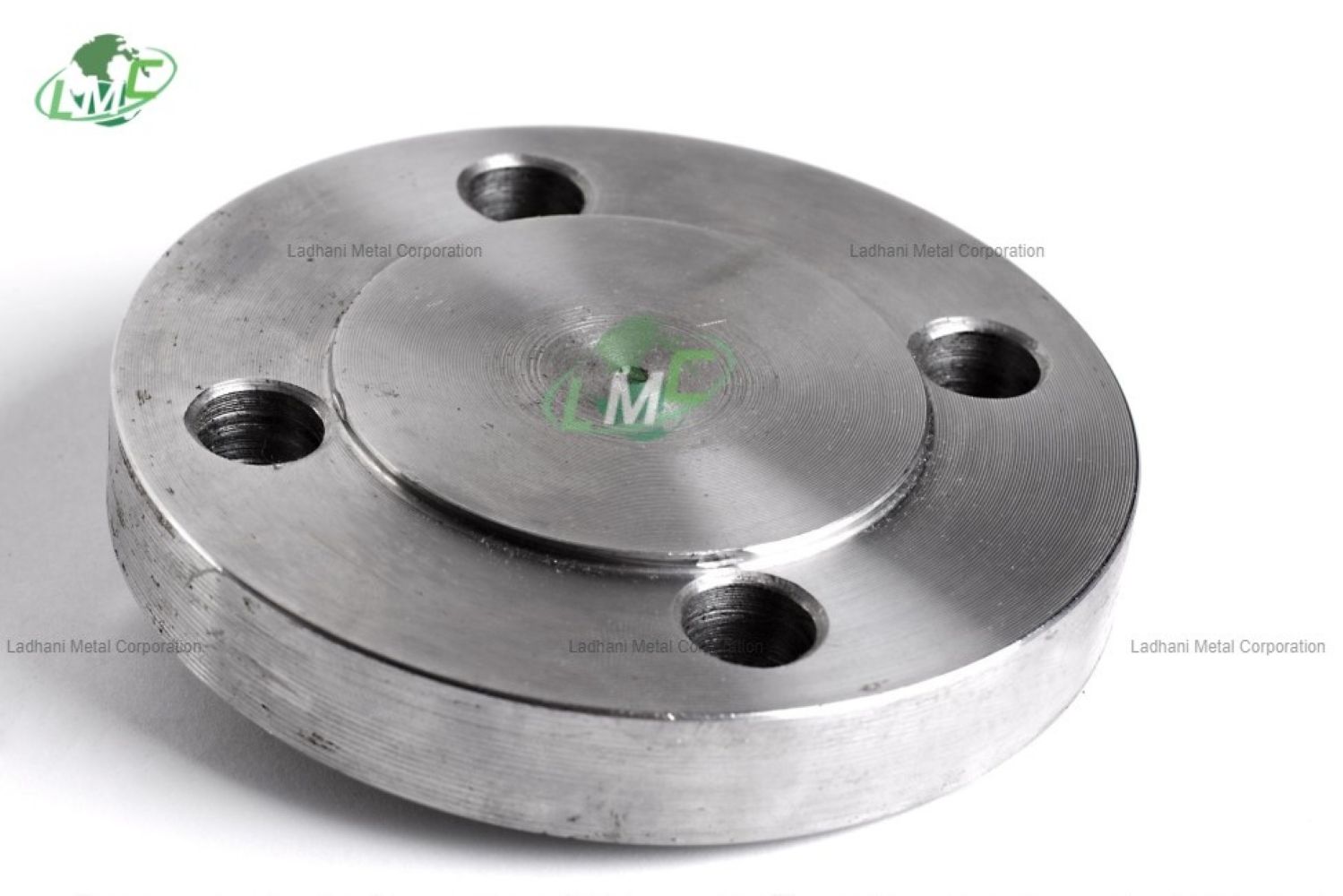

Ladhani Metal Corporation, a leading manufacturer and supplier of stainless steel products, offers DIN 2527 Stainless Steel Blind Flanges that cater to a variety of industrial needs. These flanges are crucial components in piping systems, designed to seal the ends of pipes and stop the flow of fluids, gases, or other substances. Known for their durability, corrosion resistance, and mechanical strength, DIN 2527 Blind Flanges are essential in sectors such as oil & gas, chemical, petrochemical, and marine industries. DIN 2527 Blind Flanges are essential in sectors such as oil & gas, chemical, petrochemical, and marine industries. DIN 2527 Stainless Steel Blind Flanges are particularly known for their high strength, excellent corrosion resistance, and ability to withstand extreme environmental conditions, making them essential in sectors such as chemical processing, oil & gas, marine, and power generation.
What are Blind Flanges?
A
blind flange is a flat, circular
disc used to seal the end of a pipe. It does not have a central hole, thus
preventing the flow of materials through the pipe. These flanges play a vital
role in system maintenance, pipe isolation, or in cases where pipes need to be
closed off temporarily or permanently. Blind flanges are typically bolted into
place and are available in various materials, sizes, and pressure ratings.
Types
of Blind Flanges
1.
Standard
Blind Flanges
The
most common type, these are solid circular flanges used for closing off a pipe
or fitting. They are available in various pressure ratings and materials to
meet industry standards such as ANSI, DIN, and ASME. General-purpose use in
various industries, including water treatment, petrochemical, and construction.
2. Tapped Blind Flanges
These
are blind flanges that come with a drilled and tapped hole in the center. This
hole allows for the installation of a valve, drain, or gauge. Useful in
applications where it may be necessary to access the pipeline for maintenance,
monitoring, or testing without dismantling the entire system.
3. Spectacle Blind Flanges
This
type of blind flange is part of a combination of a flange and a spacer. It
consists of a disk that can be rotated to either block the flow or allow the
flow of the material. The "spectacle" design is a form of dual
flanges, with a solid blind flange and a spacer connected by a bridge. Primarily
used in high-pressure systems or for situations where maintenance work may
require isolation of parts of a pipeline.
4. Paddle Blind Flanges
These
are lightweight and often used for low-pressure applications. A paddle blind
flange includes a simple, flat design and is made of materials that are less
prone to wear.Low-pressure systems and temporary pipeline isolation during
maintenance.
5. Ring-Type Joint (RTJ) Blind Flanges
RTJ
blind flanges feature a groove around the flange face where a metal ring is
inserted to provide a high-pressure seal. These are particularly useful in
high-pressure and high-temperature systems. Ideal for extreme pressure
applications such as in the oil and gas sector, power plants, and refineries.
6. Flat Faced Blind Flanges
These
flanges have a flat sealing face, unlike raised-face flanges. They are
typically used when the pressure in the system is low to moderate. Ideal for
systems where sealing against flanged surfaces without significant surface
imperfections is required.
7. Raised Face Blind Flanges
These
flanges have a raised face that ensures a better sealing surface when bolted
onto a matching flange. The raised face provides a greater sealing area for
high-pressure systems.Commonly used in medium to high-pressure piping systems,
including those in power plants, chemical plants, and heavy industries.
Making
of Blind Flanges
The
manufacturing process for DIN 2527
Stainless Steel Blind Flanges involves several key steps, each
contributing to the flange’s quality, durability, and precision. Below is an
outline of the typical manufacturing process:
1. Material Selection
The
first step is to select high-quality raw materials, typically stainless steel
alloys such as Grade 304, Grade 316, Grade 321, Duplex,
or Super Duplex. The material is
chosen based on the specific requirements for strength, corrosion resistance,
and temperature tolerance.
2. Forging
Forging
is the process where the raw material, often in the form of a billet or ingot,
is heated to a high temperature and then shaped using force (hammering,
pressing, or rolling). This process aligns the grain structure, enhancing the
strength of the material and improving its mechanical properties. The result is
a solid, uniform piece that can be processed further into a flange.
3. Cutting and Shaping
After
the forging process, the material is cut into the appropriate size for the
blind flange. The edges are shaped and smoothed to ensure a perfect fit with
the pipe it will be connected to. This step also involves forming the bolt
holes around the perimeter of the flange, which is essential for securing the
flange to the pipeline.
4. Heat Treatment
The
flanges undergo heat treatment to relieve
stresses caused by the forging process and to further enhance their mechanical
properties, such as hardness, strength, and resistance to corrosion. Heat
treatment processes like annealing or quenching are often applied to achieve the
desired material properties.
5. Surface Finishing
Surface finishing
processes like grinding, polishing, and sandblasting are used to ensure that
the surface of the flange is smooth and free of imperfections. This is
important, as a smooth surface ensures proper sealing when the flange is bolted
into place.
6. Drilling Bolt Holes
The
next step is the drilling of bolt holes. These
holes are critical for securing the flange to the corresponding flange or pipe.
The number, size, and positioning of the holes are precisely controlled to
ensure that the flanges can be properly aligned and securely fastened.
7. Inspection and Quality Control
The
final step involves rigorous inspection and testing to ensure that the blind
flanges meet the required standards and specifications. This includes checking
the dimensions, thickness, and overall integrity of the flange. In some cases,
flanges are also subjected to non-destructive
testing (NDT) methods like ultrasonic testing or dye penetration tests
to detect any hidden defects.
8. Packaging and Delivery
Once
the flanges pass the quality checks, they are carefully packaged to prevent
damage during transportation. The packaging is designed to protect the flanges
from environmental factors such as moisture, dirt, or physical damage. After
packaging, they are shipped to customers worldwide.
Stainless
Steel Grades and its Composition
Stainless
steel is a corrosion-resistant alloy of iron that contains at least 10.5%
chromium. It is known for its excellent resistance to corrosion, heat, and
mechanical stress. Various grades of stainless steel offer different
compositions, each suitable for specific applications. The following are the
most common stainless steel grades used for DIN 2527 Blind Flanges:
1. Grade 304 Stainless
Steel
Composition:
18% Chromium, 8% Nickel
Characteristics:
Offers good corrosion resistance, good weldability, and excellent formability.
Ideal for low to moderate temperatures.
Applications:
Widely used in industries such as food processing, pharmaceuticals, and dairy,
where corrosion resistance is vital.
2. Grade 316 Stainless
Steel
Composition:
16-18% Chromium, 10-14% Nickel, 2-3% Molybdenum
Characteristics:
Excellent resistance to corrosion, especially in marine environments. It is
highly resistant to pitting, crevice corrosion, and stress corrosion cracking.
Applications:
Ideal for use in chemical processing, marine environments, and medical
equipment.
3. Grade 321 Stainless Steel
Composition:
17-19% Chromium, 9-12% Nickel, Titanium in small amounts
Characteristics:
High resistance to oxidation and corrosion at higher temperatures. Suitable for
welding applications.
Applications:
Ideal for applications involving higher temperatures, such as exhaust systems,
heat exchangers, and boilers.
Super Duplex and Duplex Stainless Steel
for DIN 2527 Blind Flanges
4. Duplex stainless steel
Duplex
stainless steel is a family of stainless steel alloys that combine the
properties of both austenitic and ferritic stainless steel. It typically
contains 18-28% chromium, 3-10% nickel, and 0.5-5% molybdenum. Duplex stainless
steel offers high strength and enhanced resistance to corrosion, particularly
in chloride environments, where pitting and crevice corrosion are a concern.
Composition:
18-28% Chromium, 4-8% Nickel, 1.5-5% Molybdenum
Characteristics:
Good corrosion resistance in chloride-rich environments, higher strength than
regular austenitic stainless steel, and excellent resistance to stress
corrosion cracking.
Applications:
Used in offshore drilling, seawater systems, and chemical processing
industries.
5. Super Duplex stainless steel
Super
duplex stainless steel is an advanced version of duplex stainless steel. It
offers even higher strength and superior resistance to corrosion, especially in
very aggressive environments such as those found in offshore, chemical, and oil
& gas industries. Super duplex grades typically contain higher amounts of
chromium, molybdenum, and nitrogen, improving their overall mechanical and
corrosion-resistant properties.
Composition:
25-30% Chromium, 4-8% Nickel, 3-5% Molybdenum, 0.2-0.3% Nitrogen
Characteristics:
Offers exceptional corrosion resistance, particularly to pitting and crevice
corrosion, even in chloride-rich environments. It also has superior strength
compared to both austenitic and duplex stainless steel.
Applications:
Widely used in the chemical, oil, and gas industries, as well as in marine
environments and power plants.
Conclusion
Ladhani Metal
Corporation’s DIN 2527 Stainless Steel
Blind Flanges are the ideal solution for a wide range of applications
where corrosion resistance, durability, and strength are critical. Whether you
are using SS Duplex or SS Super Duplex grades, these flanges
are engineered to offer optimal performance under various environmental
conditions. With an emphasis on quality, customer service, and timely delivery,
Ladhani Metal Corporation ensures that your piping systems are equipped with
the most reliable and durable sealing solutions available in the market.
FOR REQUIREMENT OF THIS
GRADE OR FOR DETAIL CONTACT US AT :-
LADHANI METAL
CORPORATION, MUMBAI, INDIA
product links :