

⚙️ 1. Introduction to Flanges
Flanges are critical mechanical components used to join pipes, valves, pumps, and other equipment in a piping system. They provide structural support, enable system disassembly, and allow for secure, pressure-tight connections. Flanged joints are especially advantageous in systems requiring frequent maintenance or inspections.
🔧 2. What Are Flat Welding Flanges?
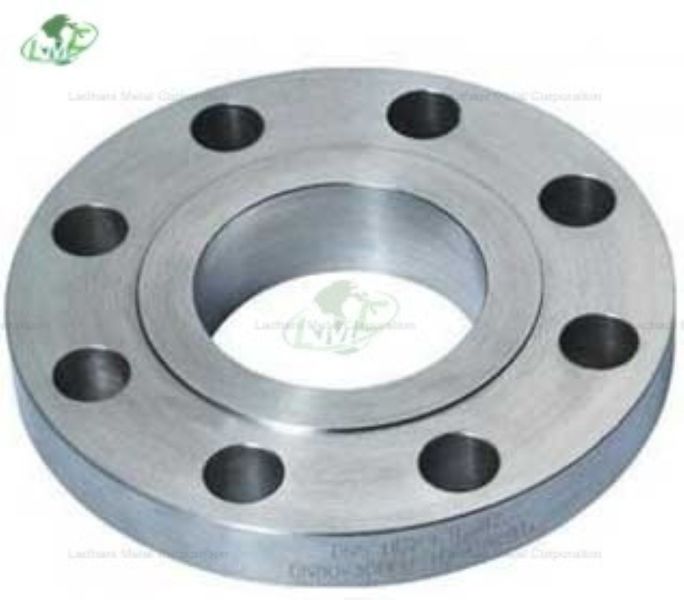
Flat welding flanges, often called plate flanges, are designed for simple and cost-effective pipeline assembly. The flange is fillet-welded to the end of a pipe, forming a smooth, flat interface for bolting with gaskets between flange faces. They are primarily used in low- and medium-pressure applications where dynamic load or thermal expansion is minimal.
🔍 Key Features:
· Flat face for use with flat gaskets
· Simple fabrication and installation
· Requires only a fillet weld
· Suitable for non-critical systems
🧩 3. Components in a Flange Assembly
A complete flat flange connection includes:
· Two flat welding flanges
· A flat gasket
· Bolts and nuts for secure fastening
· A fillet weld between pipe and flange
This setup ensures a sealed, structurally stable connection in compliant piping systems.
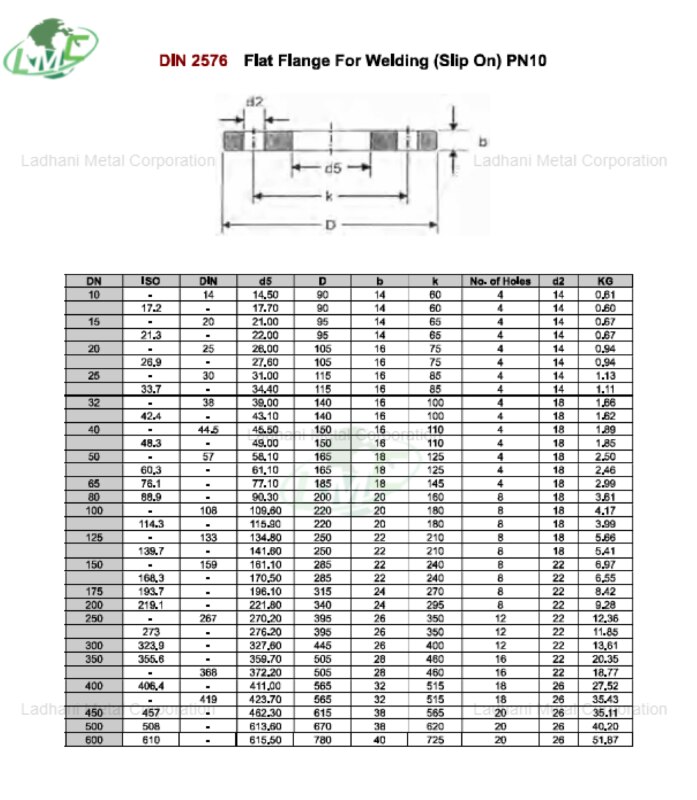
📐 4. DIN 2573 & DIN 2576 – Standard Overview
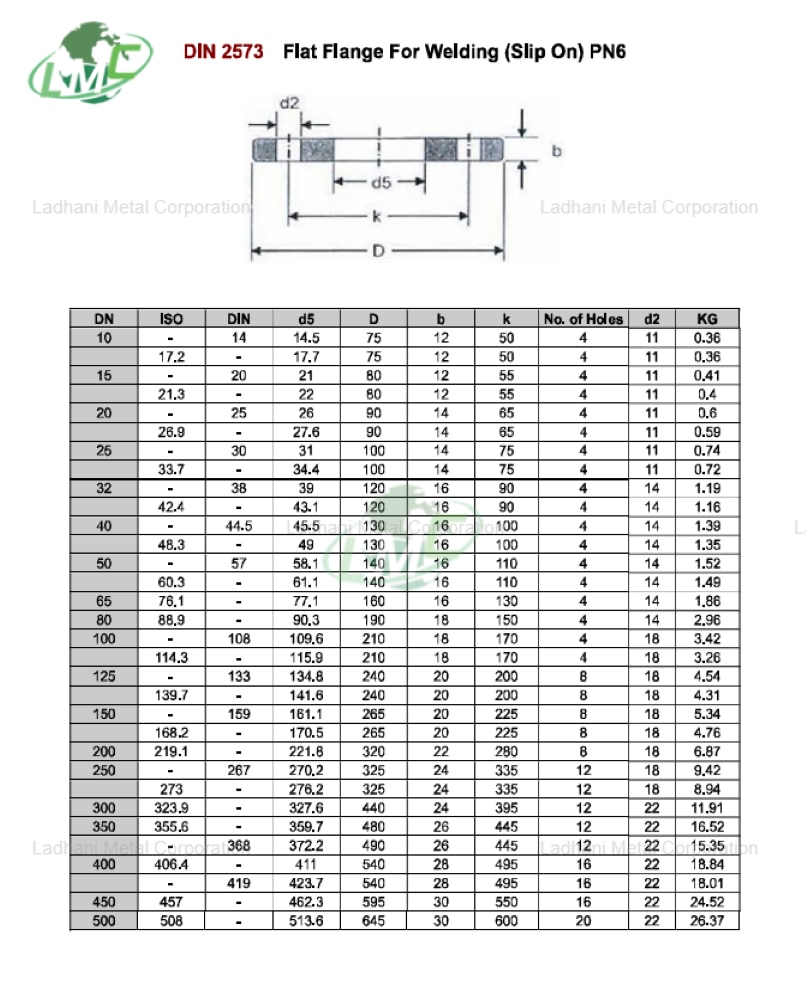
✅ DIN 2573
· Pressure Nominal (PN): 6
· Suitable for pressures up to 6 bar
· Designed for low-pressure piping systems
· Often used in water supply lines, ventilation, and agricultural piping
✅ DIN 2576
· Pressure Nominal (PN): 10
· Suitable for pressures up to 10 bar
· Used in slightly higher-pressure applications
· Common in chemical, food, and utility water systems
Both standards define dimensions, bolt patterns, and flat-faced construction compatible with flat gaskets.
🔎 5. What Is PN Rating?
PN (Pressure Nominal) is a European pressure rating system used to define the pressure handling capability of flanges and fittings. It represents the maximum allowable operating pressure (in bar) at a reference temperature (usually 20°C).
📊 Common PN Ratings:
-
PN 6 – Max 6 bar
-
PN 10 – Max 10 bar
-
PN 16, 25, 40 – Higher pressure classes for heavier-duty applications
PN ratings also influence the flange’s bolt pattern, thickness, and dimensions. Flat welding flanges in DIN 2573 (PN 6) and DIN 2576 (PN 10) are suitable for light to medium service conditions.
🏭 6. Applications of DIN 2573 & DIN 2576 Flat Welding Flanges
DIN 2573 (PN 6) and DIN 2576 (PN 10) flanges are widely used in the following applications:
✅ DIN 2573 (PN 6) Applications:
· Low-pressure water pipelines in commercial and residential buildings
· Agricultural irrigation and water treatment networks
· Ventilation and dust extraction ducting
· Drainage and non-pressurized flow systems
· Low-temperature heating and process lines
✅ DIN 2576 (PN 10) Applications:
· Medium-pressure industrial water distribution
· Low- to mid-pressure steam pipelines
· Food and beverage processing facilities
· Cooling water systems in HVAC and industrial plants
· Non-aggressive chemical pipelines in utility systems
🔬 Material Grades, Chemical Composition & Applications
🔹
1. Stainless Steel Grades
304
Stainless Steel
Composition:
· Chromium (Cr): 18–20%
· Nickel (Ni): 8–10.5%
· Carbon (C): ≤ 0.08%
· Manganese (Mn): ≤ 2.0%
· Silicon (Si): ≤ 1.0%
· Iron (Fe): Balance
Application:
Flanges made from SS 304 are ideal for general-purpose applications such as
water pipelines, food processing, and mild chemical environments due to their
excellent corrosion resistance and weldability.
316
Stainless Steel
Composition:
· Chromium (Cr): 16–18%
· Nickel (Ni): 10–14%
· Molybdenum (Mo): 2–3%
· Carbon (C): ≤ 0.08%
· Manganese (Mn): ≤ 2.0%
· Silicon (Si): ≤ 1.0%
· Iron (Fe): Balance
Application:
SS 316 flanges are preferred in marine and chloride-rich environments, such as
chemical and pharmaceutical industries, due to their superior resistance to
pitting and crevice corrosion.
321
Stainless Steel
Composition:
· Chromium (Cr): 17–19%
· Nickel (Ni): 9–12%
· Titanium (Ti): ≥ 5 × C
· Carbon (C): ≤ 0.08%
· Manganese (Mn): ≤ 2.0%
· Silicon (Si): ≤ 1.0%
· Iron (Fe): Balance
Application:
321 stainless steel flanges are commonly used in high-temperature applications
like exhaust systems and thermal processing equipment, where stabilization
against intergranular corrosion is essential.
🔹
2. Titanium Grades
Grade
2 (Commercially Pure)
Composition:
· Titanium (Ti): ≥ 99.2%
· Oxygen (O): ≤ 0.25%
· Iron (Fe): ≤ 0.3%
· Carbon (C): ≤ 0.08%
· Nitrogen (N): ≤ 0.03%
· Hydrogen (H): ≤ 0.015%
Application:
Titanium Grade 2 flanges are used in desalination plants, marine cooling
systems, and medical applications due to their light weight and outstanding
corrosion resistance, especially in oxidizing environments.
Grade
5 (Ti-6Al-4V)
Composition:
· Titanium (Ti): Balance
· Aluminum (Al): 5.5–6.75%
· Vanadium (V): 3.5–4.5%
· Oxygen (O): ≤ 0.2%
· Iron (Fe): ≤ 0.4%
Application:
Ti Grade 5 flanges are selected for high-performance applications such as aerospace,
offshore platforms, and high-pressure hydraulic systems where both strength and
corrosion resistance are critical.
🔹
3. Inconel Alloys
Inconel
600
Composition:
· Nickel (Ni): ≥ 72%
· Chromium (Cr): 14–17%
· Iron (Fe): 6–10%
· Carbon (C): ≤ 0.15%
· Manganese (Mn): ≤ 1.0%
Application:
Inconel 600 flanges are used in furnace components, heat exchangers, and
nuclear reactors due to their resistance to oxidation and high temperatures.
Inconel
625
Composition:
· Nickel (Ni): ≥ 58%
· Chromium (Cr): 20–23%
· Molybdenum (Mo): 8–10%
· Niobium (Nb): 3.15–4.15%
· Iron (Fe): ≤ 5%
Application:
These flanges are ideal for flue gas scrubbers, offshore structures, and
chemical processing plants due to excellent corrosion resistance, including in
seawater and acidic environments.
Inconel
718
Composition:
· Nickel (Ni): 50–55%
· Chromium (Cr): 17–21%
· Molybdenum (Mo): 2.8–3.3%
· Niobium (Nb): 4.75–5.5%
· Aluminum (Al): 0.2–0.8%
· Titanium (Ti): 0.65–1.15%
Application:
Inconel 718 flanges are used in aerospace turbine components, cryogenic systems,
and high-pressure chemical vessels because of their high strength and creep
resistance.
🔹
4. Monel Alloys
Monel
400
Composition:
· Nickel (Ni): ≥ 63%
· Copper (Cu): 28–34%
· Iron (Fe): ≤ 2.5%
· Manganese (Mn): ≤ 2.0%
· Carbon (C): ≤ 0.3%
Application:
Monel 400 flanges are suitable for marine piping, chemical storage tanks, and
brine systems due to their outstanding resistance to seawater and salt
solutions.
Monel
K-500
Composition:
· Nickel (Ni): 63–70%
· Copper (Cu): 27–33%
· Aluminum (Al): 2.3–3.15%
· Titanium (Ti): 0.35–0.85%
· Iron (Fe): ≤ 2.0%
Application:
Flanges made of Monel K-500 are used in sour gas wells, propeller shafts, and
pump systems requiring high strength and resistance to stress corrosion
cracking.
🔹
5. Carbon Steel Grades
ASTM
A105
Composition:
· Carbon (C): ≤ 0.35%
· Manganese (Mn): 0.6–1.05%
· Silicon (Si): 0.1–0.35%
· Phosphorus (P): ≤ 0.035%
· Sulfur (S): ≤ 0.05%
· Iron (Fe): Balance
Application:
A105 carbon steel flanges are widely used in oil & gas pipelines, steam
lines, and water distribution networks under ambient and high-pressure
conditions.
DIN
C22.8 (1.0460)
Composition:
· Carbon (C): 0.20–0.25%
· Manganese (Mn): ≤ 0.9%
· Silicon (Si): ≤ 0.4%
· Phosphorus (P): ≤ 0.045%
· Sulfur (S): ≤ 0.045%
· Iron (Fe): Balance
Application:
These flanges are employed in pressure vessels, boilers, and general structural
piping systems in industrial environments.
🔹
6. Duplex Steel
Duplex
2205 (UNS S31803 / S32205)
Composition:
· Chromium (Cr): 21–23%
· Nickel (Ni): 4.5–6.5%
· Molybdenum (Mo): 2.5–3.5%
· Nitrogen (N): 0.14–0.2%
· Manganese (Mn): ≤ 2.0%
· Carbon (C): ≤ 0.03%
· Iron (Fe): Balance
Application:
Duplex 2205 flanges are used in offshore platforms, pressure vessels, and heat
exchangers where high strength and excellent chloride resistance are required.
🔹
7. Super Duplex Stainless Steel
Super
Duplex 2507 (UNS S32750 / 1.4410)
Composition:
· Chromium (Cr): 24–26%
· Nickel (Ni): 6–8%
· Molybdenum (Mo): 3–5%
· Nitrogen (N): 0.24–0.32%
· Manganese (Mn): ≤ 1.2%
· Carbon (C): ≤ 0.03%
· Iron (Fe): Balance
Application:
Super Duplex 2507 flanges are designed for harsh environments such as deep-sea
pipelines, desalination plants, and high-chloride chemical processing systems,
offering top-tier corrosion resistance and mechanical strength.
Conclusion
DIN 2573 and
DIN 2576 flat welding flanges are essential components in light to medium-duty
piping systems, valued for their simplicity, cost-effectiveness, and
adaptability across various industrial sectors. When paired with the
appropriate material grade—such as stainless steel, titanium, Inconel, or
duplex stainless steel—these flanges deliver reliable performance in
environments ranging from basic water supply to marine, chemical, and
high-temperature systems. Understanding the pressure ratings, material
compositions, and correct application of these standards ensures safe and
efficient pipeline operation while meeting international compliance requirements.
FOR REQUIREMENT OF THIS GRADE OR FOR DETAIL CONTACT
US AT :-
Product link:
 - Material Grades, Composition, Applications & Technical Overview)