

Flanges are essential components used in various industrial applications to connect pipes, valves, pumps, and other equipment, creating a secure and leak-proof seal. Flat welding flanges that comply with DIN 2543 (PN16), DIN 2544 (PN25), and DIN 2545 (PN40) standards are widely used due to their strength and versatility. These flanges are made from several materials, including Titanium, Inconel, Monel, Duplex, Super duplex, Carbon Steel, and Stainless Steel, which are selected based on their specific applications and required properties. This article provides an overview of these materials, their chemical compositions, uses, applications, and flange structures. For those looking for high-quality flanges and metal products, Ladhani Metal Corporation is a trusted supplier offering a wide range of materials and grades to meet the demands of various industries.
1. Introduction to Flat Flanges for Welding
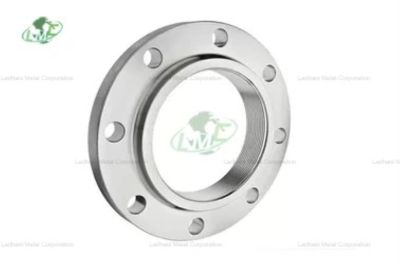
A flange is
a mechanical component used to join two sections of a pipeline, valve, or other
equipment. Flat welding flanges are designed to be welded directly onto the
pipe or equipment. Unlike raised-face flanges, flat flanges feature a smooth,
flat surface and are commonly used in applications that require a uniform seal
under moderate to low pressures.
At Ladhani Metal Corporation, we specialize in providing high-quality flat welding flanges in a variety of materials, such as Carbon Steel, Stainless Steel, Titanium, Inconel, and more, to meet the specific needs of our clients across industries.
2. DIN Flange Standards Overview
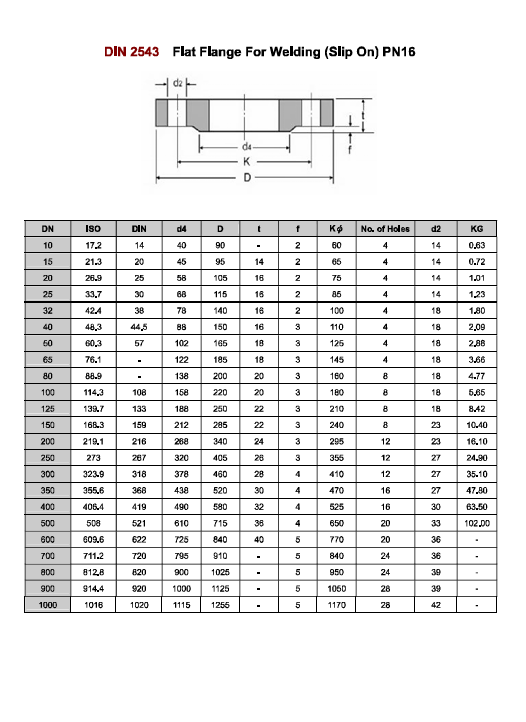
DIN 2543 (PN16): Rated
for pressures up to 16 bar (for low-pressure systems such as water pipelines
and general industrial piping).
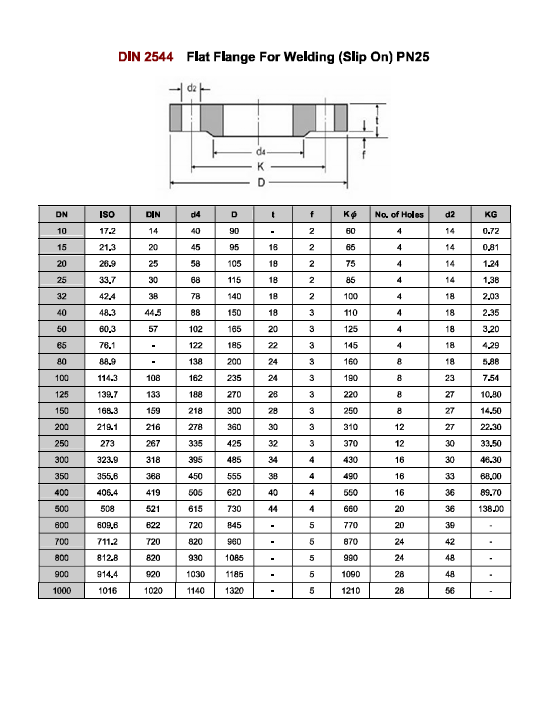
DIN 2544 (PN25):
Rated for pressures up to 25 bar (used for
moderate-pressure systems like steam lines and industrial fluid systems).
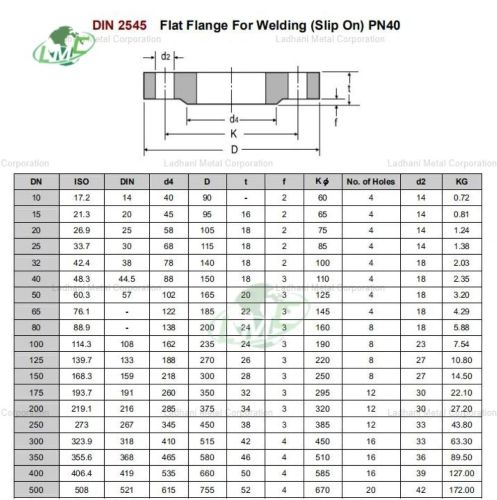
DIN 2545 (PN40): Rated for pressures up to 40 bar (used in high-pressure applications like oil and gas pipelines and chemical processes).
3. Materials Used for Flat Welding Flanges
Flat
welding flanges are made from a variety of materials, each offering distinct
characteristics suited for different industrial applications. Below is a list
of materials commonly used in the manufacture of these flanges, along with
their grades and chemical compositions.
Carbon Steel Flanges
Material:
ASTM A105, EN 10213-2
Applications:
Carbon steel flanges are ideal for low-pressure systems, such as water
pipelines, HVAC systems, and general-purpose fluid systems.
Properties:
Carbon steel provides good strength, machinability, and cost-effectiveness but
is vulnerable to corrosion in harsh environments.
Chemical Composition (ASTM A105)
Carbon (C): 0.35% max
Manganese (Mn): 0.60-1.05%
Phosphorus (P): 0.035% max
Sulfur (S): 0.035% max
Iron (Fe): Balance
Stainless Steel Flanges
Material:
ASTM A182 (Grades 304, 316, 321), EN 10213-4
Applications:
Stainless steel flanges are commonly used in corrosive environments, including
chemical processing, food processing, marine systems, and medical equipment.
Properties:
Stainless steel is resistant to oxidation, corrosion, and staining. It is known
for its strength, particularly in environments exposed to high temperatures or
aggressive chemicals.
(Grade
304 Stainless Steel, UNS S30400)
Carbon (C): 0.08% max
Manganese (Mn): 2.00% max
Phosphorus (P): 0.045% max
Sulfur (S): 0.030% max
Chromium (Cr): 18.00-20.00%
Nickel (Ni): 8.00-10.50%
Iron (Fe): Balance
(Grade 316 Stainless Steel, UNS S31600)
Carbon (C): 0.08% max
Manganese (Mn): 2.00% max
Phosphorus (P): 0.045% max
Sulfur (S): 0.030% max
Chromium (Cr): 16.00-18.00%
Nickel (Ni): 10.00-14.00%
Molybdenum (Mo): 2.00-3.00%
Iron (Fe): Balance
(Grade
321 Stainless Steel, UNS S32100)
Carbon (C): 0.08% max
Manganese (Mn): 2.00% max
Phosphorus (P): 0.045% max
Sulfur (S): 0.030% max
Chromium (Cr): 17.00-19.00%
Nickel (Ni): 9.00-12.00%
Titanium (Ti): 5x(C+N) to 0.60%
Iron (Fe): Balance
Titanium Flanges
Material:
ASTM B381 (Grade 2, Grade 5), UNS R50400, UNS R56400
Applications:
Titanium flanges are ideal for highly corrosive environments, such as marine,
aerospace, and chemical industries.
Properties:
Titanium is lightweight, highly resistant to corrosion, and can perform well at
high temperatures.
Chemical Composition (Grade 2 Titanium, UNS R50400)
Carbon (C): 0.08% max
Iron (Fe): 0.30% max
Oxygen (O): 0.25% max
Nitrogen (N): 0.03% max
Titanium (Ti): Balance
Chemical Composition (Grade 5 Titanium, UNS R56400)
Carbon (C): 0.08% max
Iron (Fe): 0.30% max
Oxygen (O): 0.20% max
Nitrogen (N): 0.05% max
Titanium (Ti): Balance
Aluminum (Al): 4.0-6.0%
Vanadium (V): 3.5-4.5%
Inconel Flanges
Material:
Inconel 600, Inconel 625, Inconel 718, UNS N06600, UNS N06625, UNS N07718
Applications:
Inconel flanges are used in extreme-temperature applications such as aerospace,
nuclear reactors, and power plants.
Properties: Inconel
provides excellent strength and resistance to oxidation, particularly in
high-temperature and corrosive environments.
Chemical Composition (Inconel 600, UNS N06600)
Nickel (Ni): 72.00-76.00%
Chromium (Cr): 14.00-17.00%
Iron (Fe): Balance
Manganese (Mn): 1.00% max
Silicon (Si): 0.50% max
Carbon (C): 0.15% max
Chemical Composition (Inconel 625, UNS N06625)
Nickel (Ni): 58.00-70.00%
Chromium (Cr): 20.00-23.00%
Molybdenum (Mo): 8.00-10.00%
Iron (Fe): Balance
Niobium (Nb): 3.15-4.15%
Titanium (Ti): 0.40-1.15%+
Chemical Composition (Inconel 718, UNS N07718)
Nickel (Ni): 50.00-55.00%
Chromium (Cr): 17.00-21.00%
Iron (Fe): Balance
Molybdenum (Mo): 2.80-3.30%
Titanium (Ti): 0.90-1.30%
Aluminum (Al): 0.20-0.80%
Monel Flanges
Material: Monel 400, Monel K-500, UNS
N04400, UNS N05500
Applications: Monel flanges are used in
marine environments, chemical plants, and other highly corrosive environments.
Properties: Monel provides excellent
resistance to corrosion, especially in seawater, acids, and alkalis.
Chemical Composition (Monel 400, UNS N04400)
Nickel (Ni): 63.00-70.00%
Copper (Cu): 28.00-34.00%
Iron (Fe): 2.5% max
Manganese (Mn): 2.0% max
Carbon (C): 0.30% max
Duplex Stainless Steel Flanges
Material:
UNS S31803 (2205), UNS S32205
Applications:
Duplex stainless steel flanges are used in oil and gas, chemical, and marine
industries, offering both high strength and corrosion resistance.
Properties:
Duplex steels provide excellent resistance to stress corrosion cracking and
pitting, while maintaining high strength.
Chemical Composition (Duplex 2205, UNS S31803)
Chromium (Cr): 22.00-23.00%
Nickel (Ni): 4.50-6.50%
Molybdenum (Mo): 3.00-3.50%
Iron (Fe): Balance
Manganese (Mn): 1.50-2.50%
Nitrogen (N): 0.08-0.20%
Super duplex Stainless Steel Flanges
Material:
UNS S32750, UNS S32760
Applications:
Super duplex stainless steel flanges are used in highly corrosive environments,
such as chemical processing, desalination, and offshore oil and gas industries.
Properties:
Super duplex flanges are resistant to pitting, stress corrosion cracking, and
maintain high strength under pressure.
Chemical Composition (Super duplex 2507, UNS S32750)
Chromium (Cr): 24.00-26.00%
Nickel (Ni): 6.00-8.00%
Molybdenum (Mo): 3.00-4.00%
Iron (Fe): Balance
Manganese (Mn): 1.00-2.00%
Nitrogen (N): 0.24-0.32%
4. Uses and Applications of Flat Welding Flanges
Carbon Steel Flanges: Used in water pipelines, low-pressure gas systems, and HVAC systems.
Stainless Steel
Flanges: Ideal
for food
processing, chemical processing, pharmaceutical industries, and marine environments.
Titanium Flanges: Best for aerospace, marine, and chemical processing industries.
Inconel Flanges: Used in high-temperature
environments like power plants, aerospace, and nuclear reactors.
Monel Flanges: Suitable for marine environments and chemical plants.
Duplex & Super duplex Flanges: Applied in offshore oil rigs, chemical processing, and seawater desalination.
5. Structure of a Flat Flange
A
typical flat
flange has
the following components:
Flange Face:
The smooth, flat surface that mates with the gasket.
Bolt Holes:
Positioned around the flange perimeter, used for bolting the flange to another
flange or equipment.
Flange Bore:
The central hole matching the pipe or equipment’s internal diameter.
Flange Thickness:
The overall thickness ensures strength and pressure endurance.
Raised Ring (if applicable): Some flanges may feature a small raised lip to help with gasket sealing.
6. Conclusion
Flat
welding flanges made from materials like Carbon Steel, Stainless Steel, Titanium, Inconel, Monel, Duplex, and Super duplex are
essential in various industries for creating reliable, high-strength
connections under different pressures and environmental conditions. Ladhani Metal Corporation provides
a wide selection of high-quality flanges, helping engineers and industries
choose the best materials and designs for their applications. Understanding the
material compositions and their applications ensures engineers can select the
best flange material for their specific needs, optimizing performance and
longevity in industrial systems.
FOR REQUIREMENT OF THIS GRADE OR FOR
DETAIL CONTACT US AT :-
Product Link:
, DIN 2544 (PN25), and DIN 2545 (PN40) – Ladhani Metal Corporation)