
Flanges are
critical components in pressure piping systems, facilitating the connection of
pipes, valves, pumps, and equipment. The DIN 2558 and DIN 2561
standards are widely used in European industrial piping systems and
international projects requiring high-quality, standardized connections.
Flanges are
essential components in pressure piping systems, enabling the secure connection
of pipes, valves, pumps, and other equipment. Among the most widely used
standards in industrial and engineering applications are DIN 2558 and DIN 2561 flanges, known for their durability, reliability, and
compliance with European norms.
Ladhani Metal Corporation, a leading manufacturer and supplier of high-performance flanges,
specializes in the production of DIN
2558 welding neck flanges and DIN
2561 threaded flanges. With a strong reputation for quality, precision,
and timely delivery, Ladhani Metal serves a wide range of industries including
oil & gas, power generation, petrochemicals, and marine systems.
This article
covers:
- DIN 2558 and DIN 2561 flange
standards
- Typical materials used (SS,
Titanium, Monel, Inconel, Duplex, Super Duplex, Carbon Steel)
- Compositions, grades,
mechanical properties
- Application scenarios and
industry relevance
DIN 2558 Flange: Welding Neck Flange (Welded Connection)
DIN 2558 defines welding neck flanges for use in pipelines where high pressure, high temperature, or cyclic loading conditions exist. These flanges are welded directly to the pipe neck, providing high structural strength and fluid continuity.
The
DIN 2558 welding neck flange features a long, tapered neck that extends from
the flange body. The neck is welded directly to the pipe, creating a smooth
transition that minimizes stress concentration. This type of flange provides
structural integrity and enhances fluid flow without sharp corners. It
typically has a raised face (RF) or flat face (FF) design and includes bolt
holes that match the pipe size.
Key
features:
- Designed for butt welding with
pipes
- Suitable for temperatures up to
600°C depending on material
- Pressure classes: PN 6, PN 10,
PN 16, PN 25, PN 40, PN 64
- Face types: Raised Face (RF) or
Flat Face (FF)
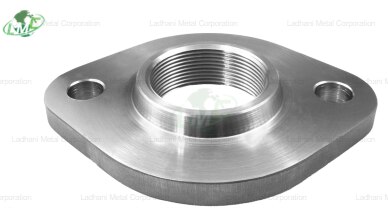
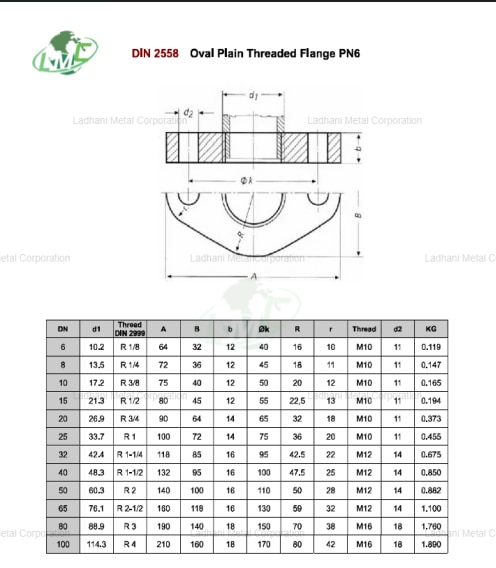
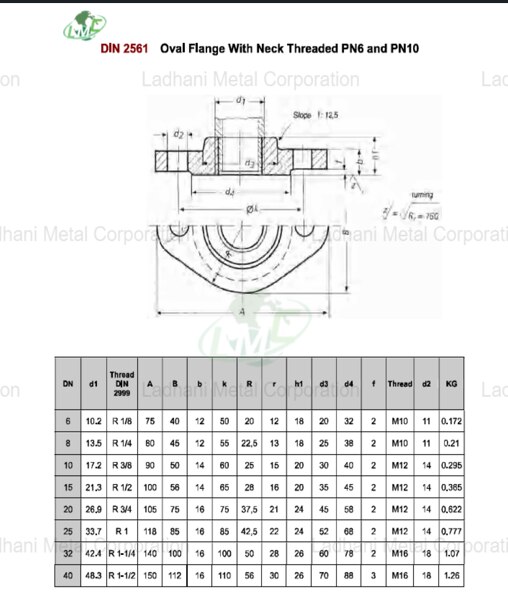
DIN 2561 Flange: Threaded/Screwed Flange
DIN 2561
flanges are threaded (ISO metric
or BSP) and are primarily used where welding is impractical or undesirable,
such as in explosive atmospheres or maintenance-intensive systems.
The
DIN 2561 threaded flange has internal threads along the bore that allow it to
be screwed onto a pipe with matching external threads. This type of flange does
not require welding, making it a quick and easy solution for connecting pipes.
The flange typically has a raised face (RF) for a better seal, and its design
allows for easy disassembly and maintenance.
Key
features:
- Internal threading for pipe
connection
- No welding required
- Ideal for small-diameter,
low-pressure piping systems
- Pressure classes: PN 6, PN 10,
PN 16, PN 25, PN 40
Materials for DIN 2558 and DIN 2561 Flanges
Materials
for flanges are chosen based on chemical compatibility, mechanical demands,
temperature/pressure conditions, and environment. Below are the primary
materials used:
Stainless Steel (SS)
Stainless
steels are used where corrosion resistance and moderate to high strength are
needed.
Common
Grades:
- 304 / 1.4301
- 316 / 1.4401
- 321 / 1.4541
Composition:
- Grade
304 / EN 1.4301
- Chromium
(Cr):
18.0–20.0%
- Nickel
(Ni):
8.0–10.5%
- Carbon
(C): ≤
0.08%
- Manganese
(Mn): ≤
2.0%
- Silicon
(Si): ≤
1.0%
- Phosphorus
(P): ≤
0.045%
- Sulfur
(S): ≤
0.03%
- Iron
(Fe):
Balance
- Grade
316 / EN 1.4401
- Chromium
(Cr): 16.5–18.5%
- Nickel
(Ni):
10.0–13.0%
- Molybdenum
(Mo):
2.0–2.5%
- Carbon
(C): ≤
0.07%
- Manganese
(Mn): ≤
2.0%
- Silicon
(Si): ≤
1.0%
- Phosphorus
(P): ≤
0.045%
- Sulfur
(S): ≤
0.03%
- Iron
(Fe):
Balance
- Grade
321 / EN 1.4541 (Stabilized
with Titanium)
- Chromium
(Cr): 17.0–19.0%
- Nickel
(Ni):
9.0–12.0%
- Titanium
(Ti): ≥ 5 ×
C (typically 0.3–0.7%)
- Carbon
(C): ≤
0.08%
- Manganese
(Mn): ≤
2.0%
- Silicon
(Si): ≤
1.0%
- Phosphorus
(P): ≤
0.045%
- Sulfur
(S): ≤
0.03%
- Iron
(Fe):
Balance
Applications:
- 304: Food-grade and pharmaceutical
processing systems
- 316 : Marine, chemical, and coastal
environments
- 321: Heat exchangers and
high-temperature applications
Mechanical Properties (Typical):
- Tensile
Strength:
500–750 MPa
- Yield
Strength:
200–310 MPa
- Elongation: ≥ 40%
- Temperature
Resistance: Up to
870°C (especially for 321)
- Grade
304 / EN 1.4301
Titanium
Titanium
offers superior corrosion resistance, especially in chlorides and seawater, and
is lightweight.
Grades:
- Grade 2 (commercially pure)
- Grade 5 (Ti-6Al-4V)
Composition
(Grade 2):
- Titanium: ≥ 98.8%
- Oxygen: ≤ 0.25%
- Iron: ≤ 0.3%
Applications:
- Seawater and desalination
systems
- Chlorine and bleach production
lines
- Aerospace fluid systems
Mechanical
Properties:
- Tensile strength: 345–450 MPa
(Grade 2)
- Yield strength: ~275 MPa
- Temperature resistance: up to
400°C
Titanium Grade 5 (Ti-6Al-4V)
- Titanium
(Ti):
90.0–94.0%
- Aluminum
(Al):
5.5–6.75%
- Vanadium
(V):
3.5–4.5%
- Iron
(Fe): ≤
0.25%
- Oxygen
(O): ≤ 0.2%
- Carbon
(C): ≤
0.08%
- Nitrogen
(N): ≤
0.05%
Applications:
- Aircraft components
- Marine and chemical processing
- Medical implants
Mechanical Properties:
- Tensile strength: 900–1,100 MPa
- Yield strength: 830 MPa
- Temperature resistance: up to
430°C
Monel
Monel is a
nickel-copper alloy with excellent resistance to saltwater and many corrosive
media.
Grades:
- Monel 400 (UNS N04400)
- Monel K500 (precipitation
hardened)
Composition
(Monel 400):
- Nickel: ~63%
- Copper: 28–34%
- Iron: ≤ 2.5%
- Manganese: ≤ 2%
Applications:
- Marine equipment
- Chemical processing involving
HF, HCl
- Oil & gas offshore
platforms
Mechanical
Properties:
- Tensile strength: 550–620 MPa
- Yield strength: 240–380 MPa
- High resistance to stress
corrosion cracking
Inconel
Inconel
alloys are high-performance nickel-chromium materials ideal for extreme
temperature and chemical conditions.
Grades:
- Inconel 600
- Inconel 625
- Inconel 718
Composition
(Inconel 625):
- Nickel: 58%
- Chromium: 20–23%
- Molybdenum: 8–10%
- Niobium + Tantalum: 3.5–4.1%
Applications:
- Heat exchangers in marine
systems
- Aerospace engines
- High-pressure steam systems
- Nuclear power systems
Mechanical
Properties:
- Tensile strength: 830–1030 MPa
- Yield strength: 415–690 MPa
- Excellent oxidation and
carburization resistance up to 1000°C
Duplex and Super Duplex Stainless Steel
These steels
combine the benefits of austenitic and ferritic SS, offering high strength and
superior corrosion resistance.
Grades:
- Duplex 2205 (UNS S31803/S32205)
- Super Duplex 2507 (UNS S32750)
Composition
(Duplex 2205):
- Chromium: 21–23%
- Nickel: 4.5–6.5%
- Molybdenum: 2.5–3.5%
- Nitrogen: 0.14–0.2%
- Iron: balance
Applications:
- Offshore oil rigs
- Fire-fighting systems
- Desalination plants
- Paper and pulp industry
Mechanical
Properties:
- Tensile strength: 620–800 MPa
- Yield strength: 450–550 MPa
- Excellent resistance to pitting
and crevice corrosion
Carbon Steel
Used for
non-corrosive environments or where cost is a major factor.
Grades:
- ASTM A105 (forged carbon steel)
- ASTM A350 LF2 (low-temp
service)
Composition:
- Carbon: 0.25–0.35%
- Manganese: 0.6–1.65%
- Silicon: ≤ 0.6%
- Iron: balance
Applications:
- Steam and air lines
- Utility piping
- Low-temperature and general
industrial use
Mechanical
Properties:
- Tensile strength: 485–655 MPa
- Yield strength: 250–355 MPa
- Good impact resistance (LF2 at
-46°C)
Applications DIN 2558 Flange (Welded Connection):
- Refineries: Used extensively for fluid
and gas transportation where high pressure and temperature are present,
such as crude oil, natural gas, and chemical refineries.
- Petrochemical
Plants: For
high-pressure pipelines and reactors that need to be sealed and securely
connected for various chemical processes.
- Steam
and Gas Turbine Systems: Welding neck flanges are integral in steam and
gas turbine systems where high-temperature and pressure conditions require
robust connections.
- Power
Generation Plants: Often
used in power generation industries (including nuclear plants) where
strong, high-pressure, and high-temperature connections are necessary.
- Offshore
Oil and Gas: The
offshore oil and gas industry uses these flanges for pipelines and
processing equipment where reliability under harsh conditions is crucial.
Applications DIN 2561 Flange (Threaded/Screwed Flange):
- Temporary
Pipe Connections:
Threaded flanges are frequently used for temporary connections in various
industries, allowing for quick installation and removal.
- Natural
Gas Lines: Used
in low-pressure gas lines where welding might be impractical or
unnecessary, ensuring a leak-tight seal.
- Flammable
Service Systems: In
applications where welding could pose a safety risk, such as in flammable
or hazardous environments, threaded flanges offer a safer, non-welded
alternative.
- Water
Treatment Plants:
Threaded flanges are used in the water and wastewater treatment industry
where piping systems require ease of maintenance and adaptability.
- Chemical
Processing: They
can also be used in chemical plants for transporting non-corrosive fluids
under low-pressure conditions.
About Ladhani Metal Corporation
Ladhani Metal Corporation is a trusted manufacturer and supplier of industrial flanges, including DIN 2558 and DIN 2561 types. With a focus on high-quality materials and precision manufacturing, Ladhani Metal offers a wide range of flanges in stainless steel, carbon steel, titanium, Monel, Inconel, Duplex, and Super Duplex alloys. Their products are widely used in industries like oil & gas, petrochemicals, power generation, and marine engineering.
Conclusion
DIN 2558 and
DIN 2561 flanges are robust, standardized components suitable for a wide range
of piping applications. By carefully selecting the appropriate material—based
on pressure, temperature, environment, and chemical exposure—engineers can
ensure durability, safety, and cost-efficiency in their systems.
FOR REQUIREMENT OF THIS GRADE OR FOR
DETAIL CONTACT US AT :-
Product Links :